– Rudolf Stingel
Nominally Italian since the post-WWI carve-up of the fallen Austro-Hungarian empire, the profoundly Tirolean city of Meran, Rudolf Stingel’s hometown, was one of the hot Hapsburg wellness destinations, a temperate valley Shangri-La teeming with aristos, adulterers, poets, gamblers and the genteelly ailing. A frequent visitor was a young Austrian doctor, the future father of psychoanalysis, Sigmund Freud. In 1900, he travelled there with his sister-in-law Minna Bernays, a trip obliquely referred to in On Dreams, where he, like Bryan Ferry would do many decades later, obsessively muses on the price of love. Lest he ‘be obliged to betray many things which had better remain my secret’, he forthwith declined to ever spill the Meran beans.
Even if you’ve encountered one of Rudolf Stingel’s earlier ‘carpet’ works, it’s scant preparation for the ambush of his recent monographic show. This is the first time that Palazzo Grassi, François Pinault’s 18th-century Venetian pile on the Grand Canal, has been given over to one artist and Stingel does indeed take it over, the work installed and unfolding over the palazzo’s entire 5000sqm. As the artist’s New York carpets did (be they the orange shag pile or kitsch casino floral), the atrium’s wall-to-wall immediately evokes place. You’re within an antique ‘oriental’ – the traditional, highly decorative Turkish patterns are essentially unaltered, albeit photographically reproduced, magnified and rewoven in a factory. Yes, it speaks to the mercantile and maritime glory of the Venetian Empire all about and its manifold borrowings and extractions, but it also catapults you headfirst into Freud’s fin-de-siècle Vienna.
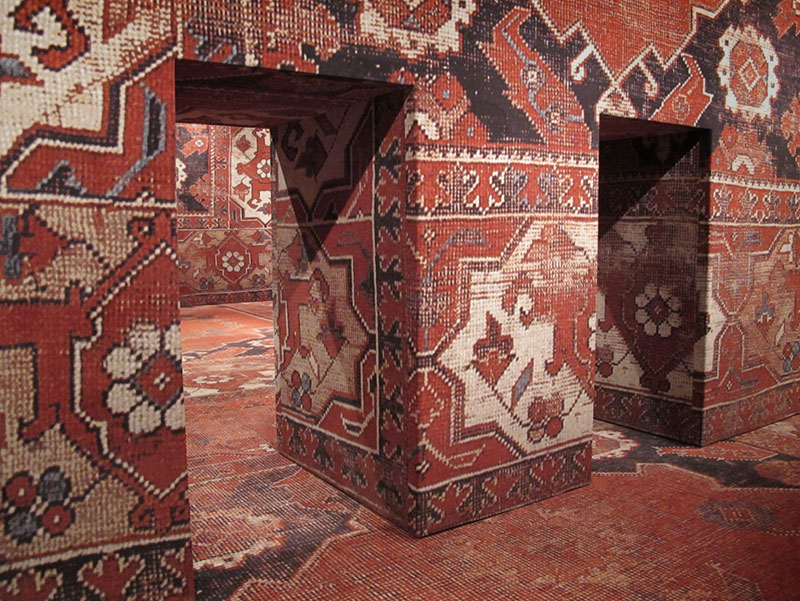
While the atrium more than hints as to what’s in store above, it’s once you are up the stairs – also carpet-lined – that things get, well, complicated. Not only does the carpet cover the floor, but also the walls, its intricate patterning relentlessly repeating and intersecting across and with the palazzo’s equally elaborate spaces. The effect is immediately disconcerting, stifling: Freud’s couch has metamorphosed, metastasized and there’s nowhere to hide.
Stingel has been producing monochromatic abstract paintings on canvas since his move to New York in the late 1980s, and a number of large silver-toned oil on enamel works in this oeuvre are hung on the first level. His ‘classics’ often function as ciphers – the artist once produced a how-to manual, an act of savvy branding, yes, but also a way of deriding the dual exceptionalism and transcendentalism of American abstraction. Here the ethereal surfaces provide a still point in the relentless patterning, as well as some pleasing Venetian mise-en-scène, evoking here and there a Fortuny silk’s shimmer or lagoon’s silvery moonlight. But, linger with them long enough, and they also offer up a mirror’s blank tain to the large representational work above and below.
On the next level hangs a series of oil on linen works, all ‘portraits of sculptures’. These photorealist depictions of wood carved Tirolean religious figures – saints, martyrs and cautionary skeletons – conjure illustrative plates from old art history texts. Stingel has repeatedly said he likes to question art’s ability to inspire awe. This might seem disingenuous given the sheer scale of the work at Palazzo Grassi, not to mention the constant toggling between dread and wonder that he seems to want to provoke, but indeed the faces that populate the upper galleries and labyrinthine, hermetic backrooms are neither awe-struck nor awe-inducing. His ‘sculpture paintings’ shown at New York’s Whitney in 2007 were seen as an act of humility in the face of (briefly) faltering mammon; here they form a touchingly quotidian chorus, a lineup drawn from distant memory. Small, tightly cropped, the snapshot focus on facial features or quirky hand movements appears to rescue each from their theocratic day job, their thrall to an absurd, vindictive Mediaeval God. Stingel returns them their humanness.
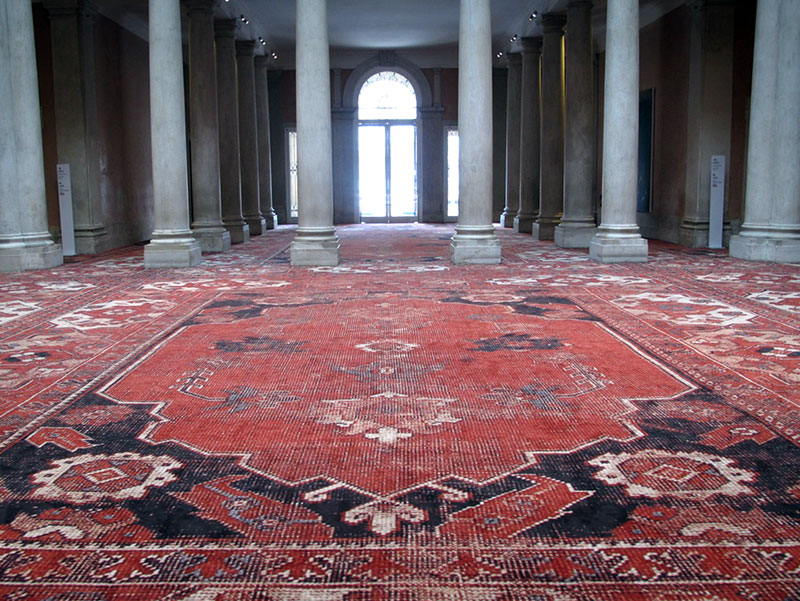
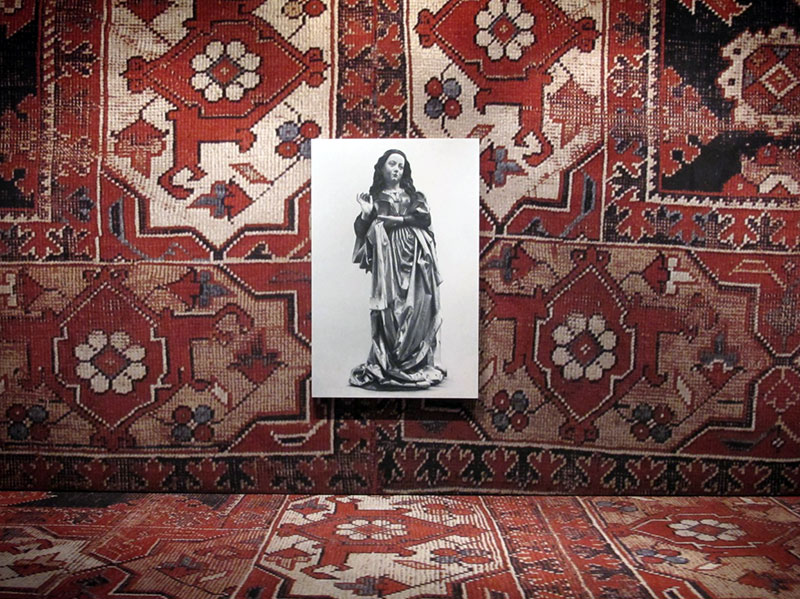
While the atrium more than hints as to what’s in store above, it’s once you’re up the carpet-covered stairs that things get, well, complicated. Not only does the carpet cover the floor, but also the walls, its intricate patterning relentlessly repeating and intersecting across and with the palazzo’s equally intricate spaces. The effect is disconcerting, stifling: Sigmund’s couch has metamorphosed, metastasized and there’s nowhere to hide.
Stingel has been producing monochromatic abstract paintings on canvas since his move to New York in the late 1980s and a number of large silver-toned oil on enamel works are hung on the first level. His ‘classics’ often function as ciphers – the artist once produced a how-to manual, an act of savvy branding, yes, but also a way of deriding the transcendentalism of American abstraction. Here the ethereal surfaces, a Fortuny silk’s shimmer or lagoon’s silvery moonlight, provide a still point in the relentless patterning, as well as some pleasing Venetian mise-en-scène. But, more importantly, they also offer up a mirror’s blank tain to the large representational work above and below.
On the next level hangs a series of oil on linen ‘portraits of sculptures’. These photorealist depictions of wood carved Südtirolean religious figures – saints, martyrs and cautionary skeletons – conjure illustrative plates from old art history texts. Stingel has said he likes to question art’s ability to inspire awe. This might seem disingenuous given the scale of the work at Palazzo Grassi and the constant toggling between dread and wonder that it provokes, but indeed the faces that populate the upper galleries and labyrinthine, hermetic backrooms are neither awe-struck nor awe-inducing. In New York his ‘sculpture paintings’ were seen as an act of humility in the face of faltering mammon; here they form a touchingly quotidian chorus, a lineup drawn from distant memory. Small, tightly cropped, the snapshot focus on facial features or quirky hand movements appears to rescue each from their theocratic day jobs, their thrall to a vindictive Mediaeval God. Stingel returns them their humanness.
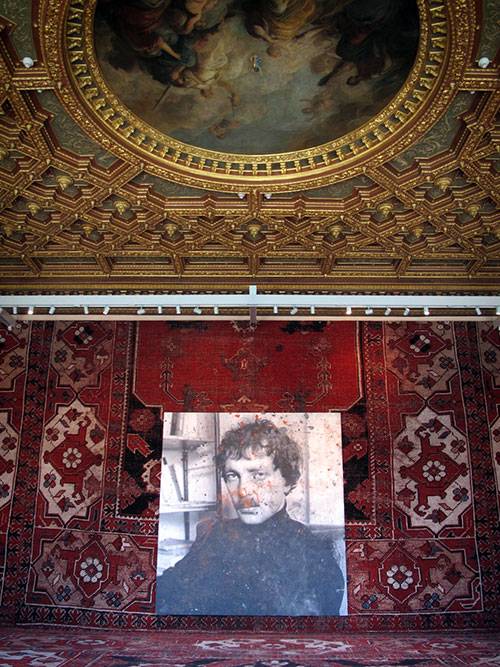
An imposing portrait of the late Austrian artist Franz West, the show’s key work, hangs in the palazzo’s correspondingly magnificent piano nobile, where you can be in no doubt this is Venice – the Grand Canal lapping right outside and the ceilings dripping with 18th-century bling – no matter how much Vienna might be mightily on your mind. Stingel’s friend and fellow artist gazes beyond you, to a city that itself seems to exist outside of time. The canvas is grimy, splattered, studio-worn: Stingel claims he accidentally left it on the floor after completion, but also concurred that a work that contested such a painting’s usual expectation of reverence would have pleased West immensely. Back down in the atrium is another grisaille work, this time a self-portrait, lurking self-deprecatingly in the shadows of a dim internal loggia, easily missed. West’s portrait above is no pristine or simple tribute, but Freud’s uncharacteristically soothing notion that ‘those who love have, so to speak, pawned part of their narcissism’ appears in play in this very placement.
Stingel’s main thing has long been painting-about-painting, but at the same time, he is not, by a long shot, a painter’s painter. His paintings are sometimes carpets, and while many of his paintings are indeed paintings, they are often also ready-mades, or paintings of photographs or paintings of photographs of sculpture. His photorealist paintings don’t seduce stylistically, instead they function as snapshots, their casualness at odds with their scale. His abstract paintings may be all the things that many a gallery-goer (Venetian day-trippers, school groups, the occasional off duty art critic) hopes a painting to be – technically tricky, conceptually solid if thematically undemanding and seductively beautiful – but in the face of easy devotion he pleads with us not to respect them, not to trust him too much, not to ask him to let you in on any secrets.
Drawn from Pinault’s and the artist’s own collections, as well as work created specifically for the site, the show isn’t a retrospective – there’s no Stingel styrofoam or tinfoil or cellotape, no Stingel jokey nowness or newness. Instead, the artist, church-going Südtirolean boy turned young Viennese-trained classical portraitist turned mid-career New York conceptual art star, re-anchors himself in the Mittle-European, his Freudian hall of mirrors a homecoming, an introspective culmination of an oft shifting and searching practice. Set loose in the threadbare weft and weave of the unconscious, you can’t be sure if you’re playing analyst or it’s you that’s being analysed. Empires and their beliefs come and go, Stingel seems to be saying, as does representation and abstraction, as do secrets and stories, as do we.
Rudolph Stingel at Palazzo Grassi
July 4 to December 31, 2013
Frieze Writer’s Prize 2013